.webp)


April 6, 2026
Searching for villa deep cleaning services Dubai? Learn how to prepare your home, what's included, and how HandyBros delivers a spotless, healthy villa.
April 7, 2026

2026-04-07T09:30:01.216Z
April 7, 2026
You notice it when the afternoon light hits the sofa. The armrest looks dull. The seat cushions feel slightly gritty. There is a faint smell that no room spray fixes, especially after the AC has been running all day.
That is normal in Abu Dhabi. Dust settles fast, sand gets carried in on clothes and shoes, and upholstery holds onto more than many realise. A couch can look acceptable on the surface and still be loaded with fine particles, body oils, food residue, pet hair, and moisture trapped deep in the fabric.
Good couch cleaning abu dhabi services do much more than brighten the fabric. They remove what a household vacuum leaves behind, protect the material from avoidable wear, and make the room feel cleaner in a way you notice. The challenge is knowing when DIY is enough, when it is not, and how to avoid providers that advertise one price and invoice another.
A sofa in Abu Dhabi works harder than many think. It catches airborne dust daily, absorbs humidity from the room, and takes constant wear from family use, guests, snacks, and pets. That mix is exactly why upholstery gets tired quickly in local homes.
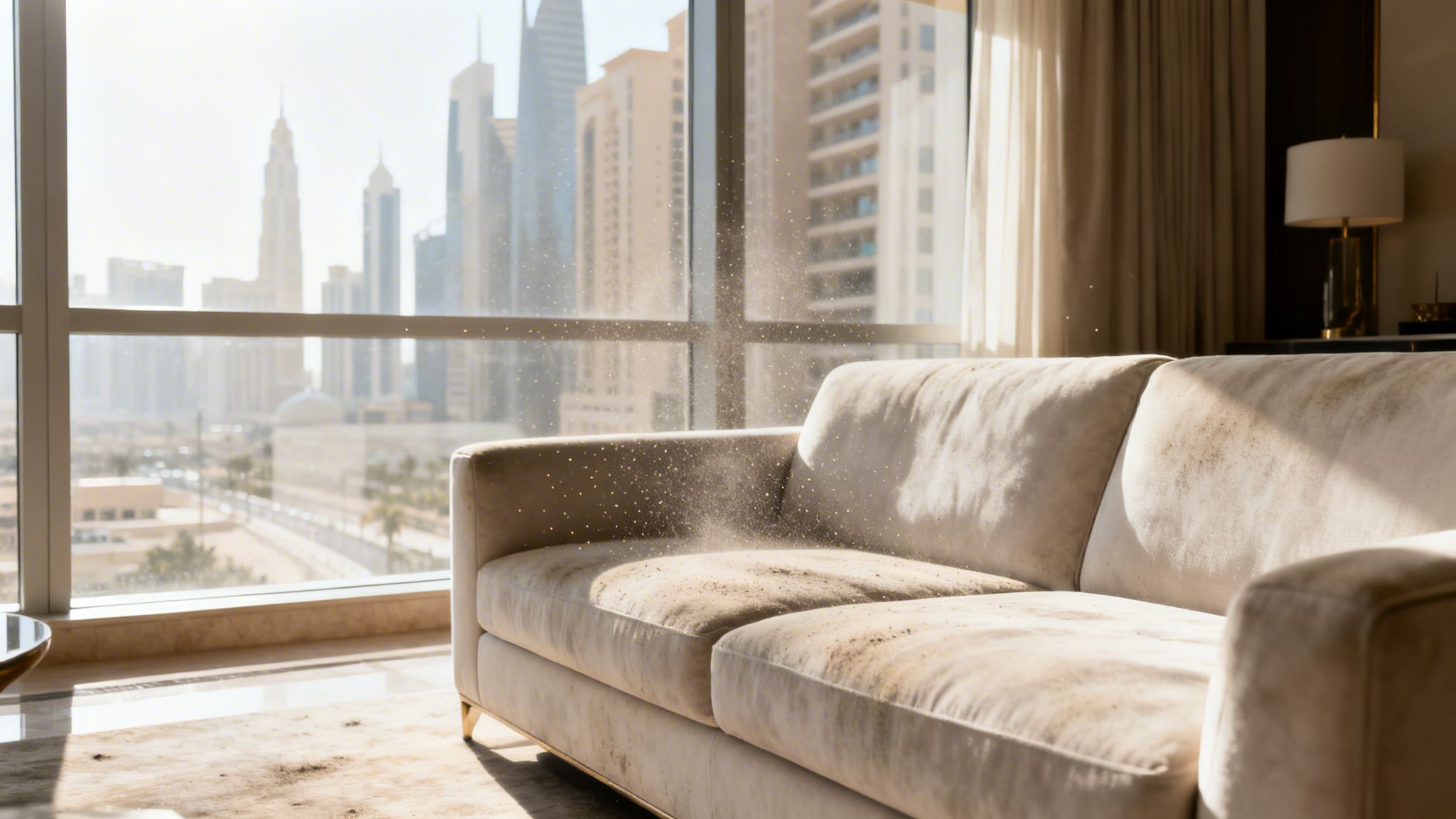
Many owners vacuum the visible areas and assume the job is done. It is not. Fine desert particles work their way into seams, under cushions, and into the padding itself. Once that happens, ordinary suction and a quick wipe stop being enough.
Professional sofa cleaning in Abu Dhabi often uses an industrial-strength pulsating vacuum with HEPA filtration that is 11 times stronger than household vacuums, extracting up to 99.97% of micro-particles like dust mites and pollen. This is then followed by steam sanitisation that kills 99.9% of bacteria and viruses, according to The Healthy Home sofa cleaning service page.
That matters because embedded dust is not just a visual problem. It changes how the sofa feels, how it smells, and how the room circulates air.
People often think of Abu Dhabi as dry only. Indoors, the picture is different. Air conditioning, closed windows, and daily temperature swings create pockets of trapped moisture in upholstery, especially in heavily used homes.
The result is familiar to cleaners. Cushions that never feel fully fresh. Fabric that starts holding odours. Corners and lower back sections that seem to get dirty again too quickly.
Practical takeaway: If your couch smells musty after the room has been shut for a few hours, the issue is usually below the fabric surface, not on it.
This is one reason regular maintenance is not optional. Waiting until the sofa looks heavily stained usually means the contamination has already moved deeper into the filling and backing layers.
A proper clean is partly about comfort and partly about preserving the sofa itself. Grit inside upholstery acts like fine abrasive material. Every time someone sits down, those particles rub against the fibres. That is how fabric starts looking flat, rough, or prematurely aged.
For homes with children, pets, or frequent guests, the build-up is even faster. Industry guidance cited by local providers commonly recommends professional cleaning at least twice yearly, and that schedule fits the way upholstery performs in this climate. Bio-On also notes that professional sofa cleaning in Abu Dhabi typically falls between AED 100 to AED 250 per seat, depending on size, fabric, and staining, on its Abu Dhabi cleaner services and prices guide.
If you already prioritise floors and rugs, upholstery should be on the same list. This is also why readers looking into broader indoor hygiene often end up reviewing services like professional carpet cleaning in Abu Dhabi, because soft surfaces collect the same local dust load in different ways.
A clean sofa is not just nicer to sit on. It helps avoid:
Abu Dhabi homes need a realistic cleaning routine. Vacuuming helps. Spot treatment helps. But neither replaces a proper deep clean done with the right machine, the right chemical for the fabric, and the right drying method.
The first question many ask is simple. Can I do this myself?
Sometimes, yes. But only for surface maintenance and fast spill response. Once the issue is deep dirt, old marks, odour, or delicate upholstery, DIY stops being the smart option and starts becoming the risky one.
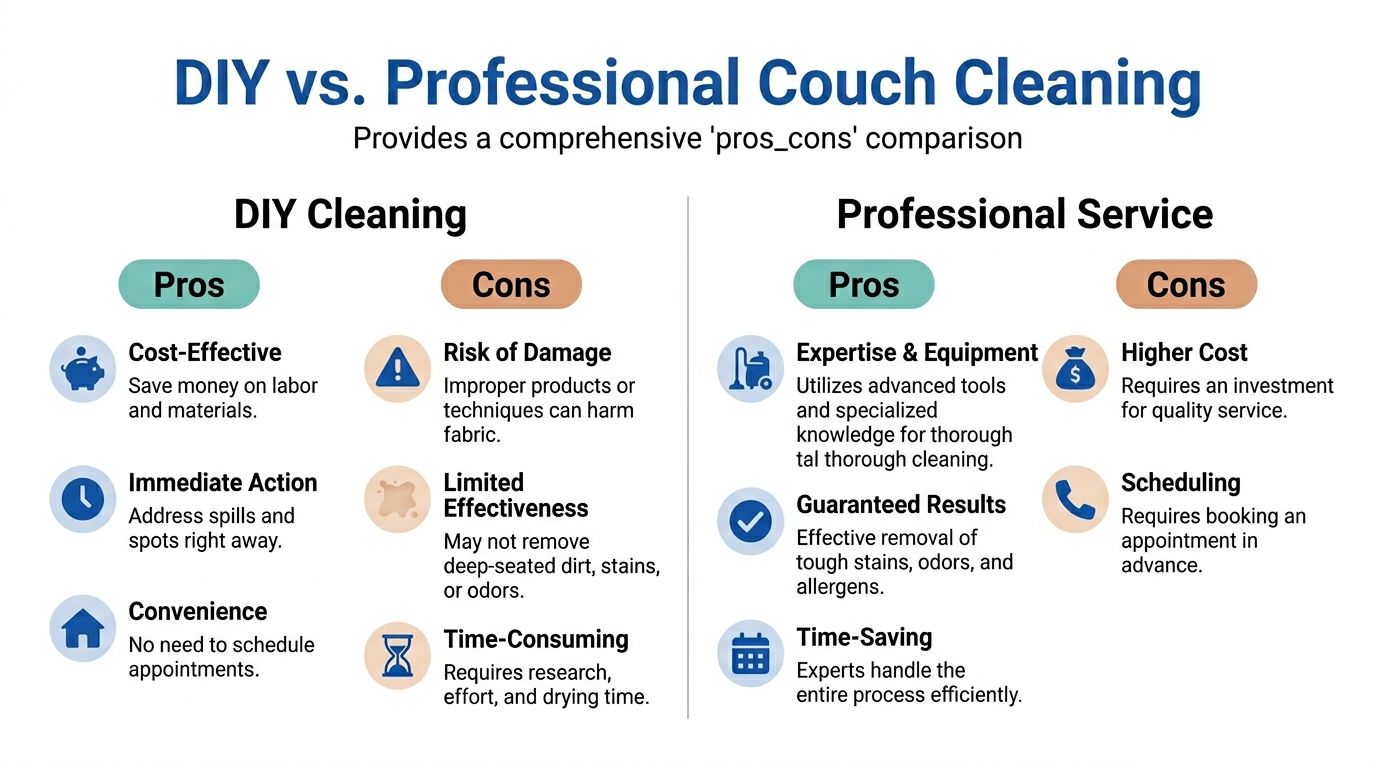
There are a few tasks homeowners should absolutely handle themselves between professional visits.
That kind of care is useful. It buys time and keeps the sofa presentable. It does not deep clean the upholstery.
The main problem with self-cleaning is that people treat all fabric like it responds the same way. It does not. One sofa can handle mild water-based treatment. Another can watermark, shrink, fade, or stiffen if you use the wrong product or too much moisture.
According to the pricing and service overview published by SmileHandyy, up to 20% of self-cleaning attempts result in some form of fabric damage, while professional steam cleaning can eliminate 99% of allergens in the process of cleaning. That same source is available on SmileHandyy’s UAE sofa cleaning cost guide.
The damage usually comes from a few mistakes:
Tip: If a stain has already dried, avoid pouring more water onto it without knowing the fabric type. That often makes the clean-up harder, not easier.
Professionals are not just bringing a machine. They bring process. The better teams inspect the fabric first, test products in a safe area, and match the method to the upholstery rather than forcing one technique onto everything.
Here is the trade-off in simple terms:
| Approach | Best for | Main risk | Result quality |
|---|---|---|---|
| DIY cleaning | Quick spill response and light upkeep | Fabric damage, residue, slow drying | Limited |
| Professional cleaning | Deep dirt, odours, allergen removal, delicate fabrics | Higher upfront cost | Thorough and safer |
A good cleaner also manages drying properly. That is a big deal in Abu Dhabi homes where enclosed rooms and constant AC can create uneven drying patterns. A sofa that is left damp beneath the top layer rarely smells fresh for long.
DIY looks cheaper because you only see the bottle, brush, or rental machine. You do not see the cost of a ruined cushion cover, texture loss on suede, or a sofa that still smells dirty after all that effort.
Professional work costs more upfront, but it is often the cheaper decision over the life of the furniture. If the couch matters to the room and replacing it would be painful, the safer choice is to clean it properly the first time.
The gap between a good cleaning company and a poor one is not small. It shows up in the quote, the equipment, the drying result, and the way the sofa looks a week later.
Low advertised rates are common. The issue is what gets added later. Fabric surcharges, stain-treatment fees, VAT, parking, location charges, and “extra dirty” add-ons can turn a cheap booking into an expensive one.
A local service comparison notes that many providers advertise low starting rates but fail to disclose extra charges, and that up to 30% of home service complaints in Abu Dhabi stem from unclear pricing. It also recommends asking one direct question: “What is the all-in quote for my couch, including VAT and any potential surcharges?” That guidance appears on ServiceMarket’s Abu Dhabi sofa upholstery cleaning page.
That question filters weak providers fast.
Do not settle for “starting from” pricing. Ask for the full scope in writing.
Use this checklist:
A serious company answers without hesitation. A weak one stays vague.
Some warning signs show up before anyone arrives:
Best practice: Send clear photos from the front, side, and close-up of any stained areas. A company that studies those images before quoting is usually more organised on-site too.
The stronger operators are straightforward. They explain the method, give a proper range only when they need to inspect, and flag likely extras before the visit, not after the work is done.
They also understand villa realities in Abu Dhabi. Access time, larger sectionals, majlis seating, and family-use wear patterns all affect the job. A cleaner who has only worked on small apartment sofas often misquotes larger homes.
For couch cleaning abu dhabi bookings, transparency is not a bonus feature. It is one of the clearest signs that the company knows its trade and expects to stand behind the result.
When a professional team handles the job properly, the appointment feels organised from the start. The cleaners do not rush straight into spraying chemicals. They assess first, then clean in a sequence that protects the fabric and improves the result.
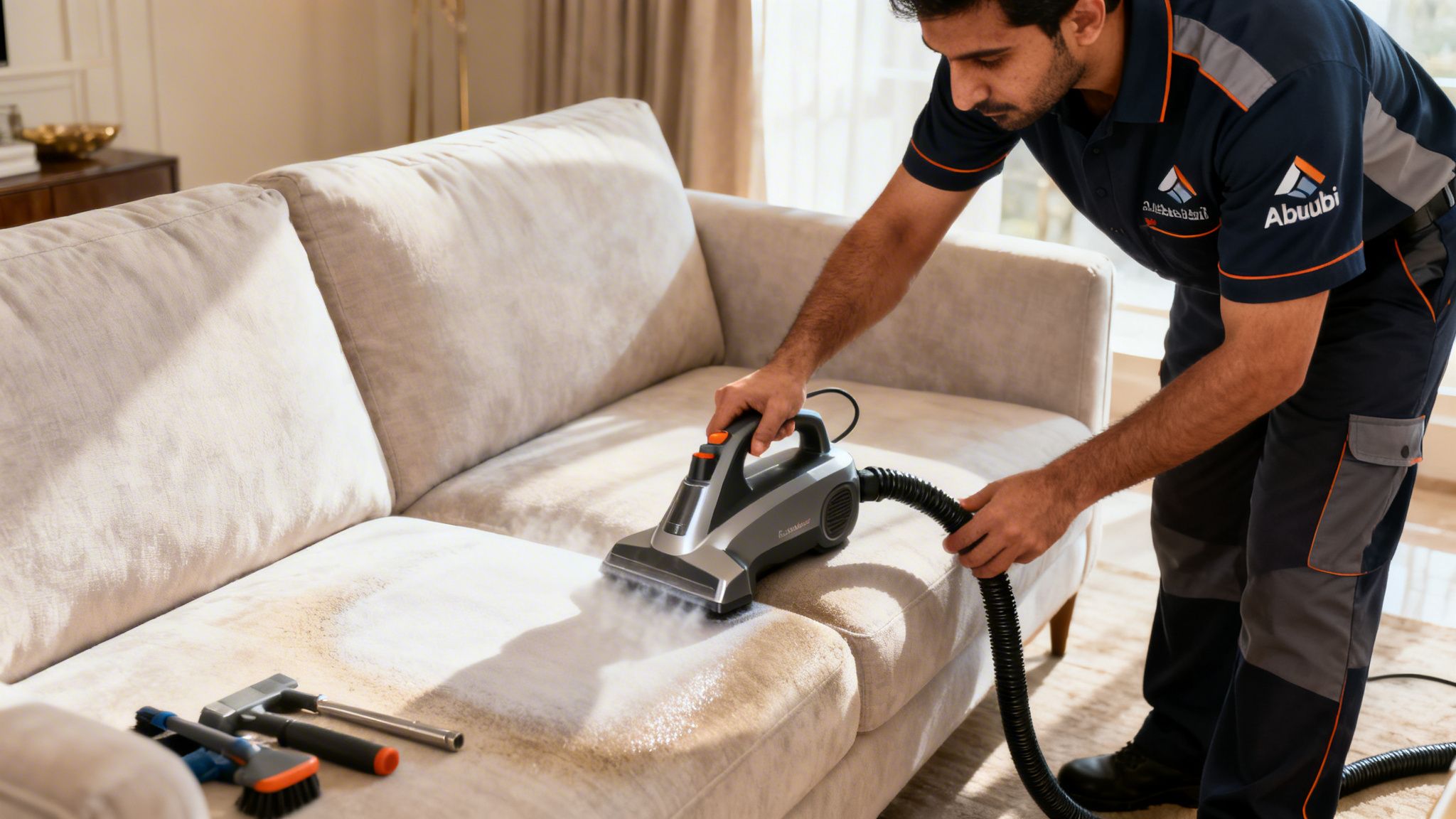
The technician should check the upholstery type, look for wear points, identify stains, and note any previous DIY attempts that may have left residue. This is the stage where an experienced cleaner spots problems like colour sensitivity, shrinkage risk, or old spill rings.
They also check cushions, seams, armrests, and the back panel. Those areas often carry different levels of soiling, especially in family homes.
Dry debris has to come out before any wet cleaning starts. If it does not, it turns muddy once moisture is added and gets pushed deeper into the fabric.
Urban Company describes a 3-step rotary extraction process that starts with dry vacuuming, followed by wet shampooing with fabric-specific chemicals, and then powerful wet vacuuming. According to its Abu Dhabi service page, this method reaches 85-95% stain and dirt removal efficiency on common upholstery such as microfiber and suede while also tackling germs and odours on Urban Company’s professional sofa cleaning page.
That first dry stage matters more than many people realise. It is what clears the crumbs, sand, loose dust, and hair from creases and under the seat line.
After vacuuming, the cleaner applies the appropriate solution to soiled zones. This is not random spraying. The chemical should be chosen based on both the fabric and the type of contamination.
Typical target areas include:
Good cleaners allow the product to dwell briefly. That gives it time to loosen soil before extraction begins.
A similar staged approach is used in broader residential hygiene work such as deep cleaning for the whole house, where the sequence matters as much as the product.
This is the part most clients think of as the main clean. In reality, it only works well if the earlier stages were done properly.
The machine agitates and lifts contamination, then recovers the suspended dirt and moisture. That extraction stage is what separates professional cleaning from ordinary shampooing. Without recovery, residue stays behind and the sofa gets dirty again faster.
For readers who want to see the kind of equipment and method involved, this walkthrough gives a useful visual reference:
A proper appointment ends with inspection, not packing up. The technician should review any permanent staining, explain what improved, and tell you how to help the sofa dry evenly.
Aftercare tip: Keep the room ventilated and avoid heavy use until the upholstery is properly dry. Putting cushions back too early can trap moisture where you cannot see it.
When the process is done well, the couch looks brighter, smells cleaner, and feels lighter to sit on. It dries clean instead of drying sticky or stale.
Professional cleaning fixes deep problems. Daily habits stop those problems from building up too quickly. In Abu Dhabi, that maintenance matters because soft furniture collects fine dust even when the room looks clean.
Most sofa care advice online is too generic. In UAE homes, the useful habits are the simple ones done consistently.
Start with this routine:
If the home already follows a regular whole-home routine, upholstery care fits naturally alongside services such as general home cleaning support, which helps reduce the dust load across all soft surfaces.
Speed matters more than force. Scrubbing hard usually spreads the stain and pushes it down.
Use this order instead:
The biggest mistake with fabric upholstery is over-wetting it. People often assume more water means a better clean. Usually it means longer drying, rings, and trapped odour.
For fabric sofas:
Expert tip: If a cleaned spot feels stiff after drying, there is probably residue left in the fibres. That area needs proper extraction, not another round of spray.
Leather sofas in air-conditioned homes have their own pattern of wear. They do not trap dust in the same way as fabric, but they do show body oils, dullness, and dryness more quickly.
Good habits for leather include:
If leather starts looking patchy, sticky, or overly matte, stop experimenting. Wrong products can alter the finish faster than people expect.
Where the sofa sits in the room affects how fast it ages.
Try to avoid:
There is a point where maintenance stops being enough. If the couch still looks flat after vacuuming, smells off after the room is closed, or shows darkening on headrests and arms, it needs a proper deep clean.
Home care is there to preserve the result between professional visits. It is not meant to replace them.
The two questions that matter most are usually the same. How much is this going to cost, and how long will it take?
In Abu Dhabi, most sofa cleaning quotes depend on the shape of the couch, the fabric type, and how much work the stains require. That is why one provider quotes quickly while another asks for photos first. The second approach is usually more reliable.
According to Bio-On’s Abu Dhabi pricing guide, professional sofa cleaning services typically cost AED 100 to AED 250 per seat, with the final price affected by size, fabric, and the extent of staining. The same source notes that many experts recommend a deep clean at least twice a year in this climate because dust and allergens build up quickly in upholstery.
That per-seat model is common, but it is not universal. Some companies quote per sofa, while others price by configuration.
Here is how to read the quote properly:
| Pricing style | What it usually means | What to confirm |
|---|---|---|
| Per seat | Each sitting section is counted separately | How corner units and chaise sections are counted |
| Per sofa | One fixed amount for the whole item | Whether L-shapes and recliners are included |
| Custom quote | Price based on photos or inspection | Whether stain treatment and VAT are already included |
A fair quote usually changes for practical reasons, not arbitrary ones.
The biggest factors are:
If a company gives the same price for every couch without asking questions, that is usually a warning sign.
Cleaning time depends on the size and condition of the sofa, but clients should expect setup, inspection, treatment, extraction, and a final review. It is not a ten-minute task if done properly.
Some local providers state that sofa cleaning sessions can average 2-4 hours, depending on the piece and the condition being treated, as noted in the earlier market data provided by SmileHandyy. What matters more than the exact duration is whether the cleaner is following a proper process instead of rushing through visible surfaces only.
People often ask how long the technician will be there. The better question is when the sofa will be ready for normal use again.
Drying depends on fabric density, room ventilation, and how much moisture was used during the job. A well-executed service should leave the sofa only moderately damp, not soaked. If it feels heavy with water afterwards, the extraction stage was likely poor.
Booking tip: Ask both questions before confirming. “How long will the appointment take?” and “How long before we can use the couch normally?” Those are not the same thing.
For couch cleaning abu dhabi services, transparent pricing and realistic time expectations usually go together. Companies that explain one clearly tend to explain the other clearly too.
A practical baseline is at least twice a year, especially in homes dealing with regular dust, children, pets, or daily heavy use. That recommendation appears in the earlier cited Bio-On local pricing guidance. Some households need more frequent attention, but biannual cleaning is a sensible starting point.
That depends on the company and the fabric. Ask what products they use, whether they are fabric-specific, and what drying guidance they give after the appointment. A professional service should answer clearly and explain any precautions instead of brushing the question aside.
Sometimes yes, sometimes no. The age of the stain, the type of spill, the fabric, and any past DIY treatment all affect the result. A good cleaner will be honest. Improvement is often realistic even when complete removal is not.
Not always. The right method depends on the upholstery and the condition of the sofa. Some materials respond well to steam-based sanitising and extraction. Others need a lower-moisture or more specific approach. A cleaner who decides after inspection is usually making the better call.
Clear small items from the sofa and nearby tables. Remove throws, loose covers, and personal belongings. If there are specific stain areas, point them out early. Good access helps the cleaner work properly around all sides and cushions.
Ask for the full quote in writing, including VAT and any extra charges linked to fabric, stains, or access. That one question prevents a large share of the frustration people face with budget bookings.
Usually, yes, if the frame and structure are still sound. Deep cleaning can improve appearance, comfort, and odour enough to make the sofa feel usable again. If the upholstery is tearing or the filling has collapsed, cleaning helps less, but a proper inspection will tell you that quickly.
If you want dependable help with transparent quotes, organised booking, and warranty-backed service, HandyBros Dubai is the team to contact. They are the right choice when you want clear communication, professional standards, and a service experience that does not leave you guessing about price, process, or results.


April 6, 2026
Searching for villa deep cleaning services Dubai? Learn how to prepare your home, what's included, and how HandyBros delivers a spotless, healthy villa.

April 5, 2026
Learn how to use a safety tank cleaner for pristine water in Dubai. Our guide covers preparation, cleaning, and when to call trusted professionals.
Ready to work with us?

Reliable AC, plumbing, electrical, and handyman services in Dubai — fast, safe, and expertly handled for homes and businesses. Contact us today!


Copyright © Handybros
.png)


